


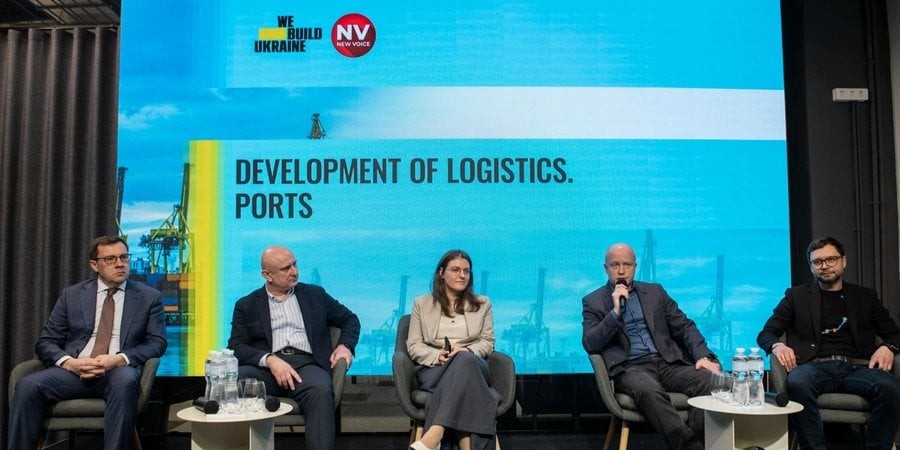
The We Build Ukraine think tank held a conference “Logistics as a driver of economic growth”. What problems need to be solved in different areas - railways, port infrastructure and air transportation, in order to get the best economic effect? Owners and top managers of various businesses, representatives of embassies and government organizations gathered to discuss the problems and prospects of the logistics industry. The We Build Ukraine think tank, led by Oleksandr Kubrakov, brought together the strongest experts in the industry at the conference “Logistics as a driver of economic growth”, which discussed problems and opportunities for the growth of railway and port infrastructure, prospects for air transportation and the search for financing. What did the experts talk about? Why is it important to analyze? The We Build Ukraine think tank is engaged in the development and implementation of reforms, attracting investments for the transformation of the economy and the development of Ukraine’s infrastructure. “We see what happened to our economy during the war — we lost part of our GDP, territory, and people, but at the same time we gained new opportunities,” says Oleksandr Kubrakov, founder of We Build Ukraine. “Ukraine gained access to European markets, new technologies, and some of our industries, such as defense, received a significant boost during the war, and this is becoming the basis for our future growth.” Logistics, together with access to financing, the availability of labor, and developed IT and telecom infrastructure, accelerates reform and attraction of investments in key sectors of the economy. Agriculture, subsoil use, construction, mechanical engineering, energy, defense production, and IT — the transformation of these sectors, according to BCG, will have the greatest effect on increasing the country’s GDP. These 8 sectors are priorities for reform in Ukraine and attracting public and private investments. This is stated in the Strategy for Economic Growth of Ukraine, developed jointly by the Boston Consulting Group (BCG) and the We Build Ukraine think tank. Oleksandr Kubrakov emphasizes that each sector has 5-10 problems, the solution of which will ensure growth in these industries. The organization is currently holding its fourth sectoral event. Based on the results of each, an analytical document is being prepared, which indicates the key challenges that prevent a particular industry from developing and suggests ways to overcome them. What exactly needs to be changed and how to work with the logistics industry - experts provided their answers during the third conference "Logistics as a Driver of Economic Growth".
Tracks to the West The EU has many expectations for Ukraine's transport and logistics systems, admits Alan Baron, policy officer of DG MOVE (Directorate-General of the European Commission for Transport within the European Union). He says that he started working on "Solidarity Pathways", that is, the system created by the European Commission to support the export of Ukrainian grain and other products, back in May 2022. “We have found a difficult situation at the borders between Ukraine and the EU from a logistical point of view,” he says. Some border crossings, in particular road ones, do not have sufficient capacity, and better access roads are also needed on both sides of the border.
Alan Baron says that border control and border infrastructure are not adapted to the future path of Ukraine’s accession to the European Union. “The agreement on road transport, which was a significant advantage for Ukraine in terms of access to the EU market, played an important role in reducing the competitiveness of rail transport,” says Alan Baron. “We are better connected by road than by rail, and we need to take this aspect into account.”
Ukrainian railways are adapting to EU requirements. Deputy Minister of Finance of Ukraine Oleksandr Kava said that the Chop-Uzhhorod Eurorail is planned to open this summer, and this project is financed 50% by the Connecting Europe Facilities (CEF) and 50% by the state budget. “This will not only allow direct passenger trains from Uzhhorod to Budapest, Bratislava, Prague, Vienna, Dresden, but will also allow shippers in Uzhhorod to immediately send cargo to their partners in Europe. And also receive goods, containers and materials directly in Uzhhorod,” he says. Another project is the construction of a Eurotrack to Chernivtsi, which may begin next year. “Chernivtsi should become the second regional center after Uzhhorod to receive a Eurotrack directly in the city. Infrastructure is not the only challenge for Ukraine in the railway industry, Alan Baron admits. It is important that Ukraine begins to implement a package of reforms to bring railway legislation into line with European legislation. “We ask that regulatory authorities be created as the first step in implementing this important package of reforms in the railway sector,” Alan Baron notes. “These will be bodies independent of railway managers or railway operators, which will will address security issues, as well as other aspects of regulating rail transportation in Ukraine.
High tariffs, state ownership
Ukraine has no shortage of port and warehouse infrastructure — everything is functioning efficiently, but we need to work to reduce the cost of port logistics, says Yuriy Vaskov, co-founder of the We build Ukraine think tank, Deputy Minister of Community, Territorial and Infrastructure Development (2021−2024). The expert talks about several issues that are important for the development of ports. One of them is fees. The existing model of financial administration of these funds is inefficient, reducing the competitiveness of exporters. Even more — 90% of the money, instead of development, construction of new canals, water areas and other strategic facilities, goes to the general budget fund. Business has been waiting for a reduction in port fees for many years, but so far this is not possible.
Another challenge is the significant participation of the state and state assets in economic activity. “The same law on seaports states that the forms of investment in ports and infrastructure are lease, concession or privatization. Unfortunately, none of these forms are currently working effectively,” admits Yuriy Vaskov. “We know that the state, no matter how transparently it tries to work, will not provide the same efficiency in economic and commercial activities as the private sector.”
Where to get the money?
Over the past three years, we have become more numerous, we have started delivering parcels faster, and 128 of our branches operate in 16 countries, says Vyacheslav Klimov, co-owner of the NOVA group of companies. “For us, all these three terrible years, paradoxically, were and are a period of very active development,” he says. The company has several sources of financing for its development. The key is profit, and 80-85% of the funds are now reinvested. Financing from international financial structures is attracted for large infrastructure projects that cannot be implemented on our own. A recent example is that in August last year, the EBRD provided the company with 70 million euros to finance the NOVA Group’s investment program. “Ukrainian banks, and this was a surprise to me, have become reliable partners for businesses like us that create real products,” he says. Vyacheslav Klymov names the company’s bonds as the fourth source of financing.
When will we fly? After the war ended and the Ukrainian sky was opened, airlines are preparing to return to the largest airports. A top manager at Wizz Air said that the airline has developed a plan to create a network of about 100 routes in the first six months after the resumption of flights, which will allow it to provide an annual capacity of 5 million people. According to Varady, the airline is very close to concluding commercial agreements with the Kyiv and Lviv airports.
Ryanair CEO Michael O’Leary said that in July 2023 he visited Ukraine and met with representatives of Odessa, Lviv and Boryspil airports. “We have developed an ambitious plan that provides that in the first year after the opening of the sky we will deliver 5 million passengers to Ukraine. And in five years we will increase this figure to 10 million passengers, and this growth will be faster than in Poland,” he says. But, says Michael O’Leary, he cannot agree with Ukrainian airports. “I don’t understand why they are not preparing to resume flights, not concluding an agreement with Ryanair,” says Michael O’Leary. However, he admits that in this case the volumes of transportation may turn out to be much more modest.