


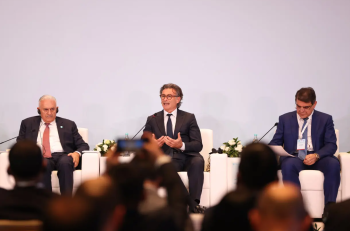
Cargo flows along the Middle Corridor are growing rapidly. However, growing problems may limit the potential for growth and development. IRU presented the solution at the International Forum on Multimodal Transport in Tashkent, Uzbekistan.
The International Forum on Multimodal Transport, organized by the Alliance of Logistics Centers and Freight Forwarders of the Organization of Turkic States (OTS) in cooperation with the Ministry of Transport of Uzbekistan, brought together leading transport and logistics companies, business associations and stakeholders from across the region.
It provided a platform for constructive dialogue, with a particular focus on the development of multimodal routes along the Middle Corridor, which spans Eurasia from China to Europe via Central Asia, the Caucasus and Turkey.
IRU Secretary General Humberto de Pretto, who spoke on the first panel, said: “We operate in an environment defined by the constant challenges facing global supply chains.”
“It is surprising that, a millennium later, we are once again discussing how to revive the ancient Silk Road trade routes to stimulate trade and improve transport connectivity.”
Inspired by the region’s rich history and untapped potential, the IRU launched the New Eurasian Land Transport Initiative (NELTI) some 25 years ago. It proved to be a visionary initiative.
NELTI examined the feasibility of long-haul freight transport across Eurasia, including connecting China to Europe via northern, southern and central routes. The central transport route is now known as the Middle Corridor.
Since 2022, many logistics players have turned to the Middle Corridor as a viable alternative to traditional transit routes. Its freight volume is expected to triple by 2030 compared to 2021.
Trade along the Middle Corridor is also growing. Previously dominated by raw materials such as oil and minerals, it is now rapidly shifting to container traffic, which has more than tripled in the last 12 months. Over 60% of container traffic is Chinese goods bound for Europe.
The number of trucks and trailers on this route has increased from 3,000-5,000 vehicles in 2015 to over 19,400 vehicles in 2022, with a potential capacity of up to 40,000 vehicles, depending on the availability of RO-PAX ferries.
“This huge growth in freight traffic along the Middle Corridor has brought both opportunities and challenges that require coordinated action,” said Humberto de Pretto.
Solutions to the challenges of growth
Border crossings along the Middle Corridor are under pressure. Congestion and long queues are now the norm.
The time it takes to cross the corridor can also vary significantly. In some cases, transit is quite fast. , but shippers need predictability and reliability. These problems arise not so much from infrastructure deficiencies as from the incorrect and unharmonized implementation of existing instruments. With TIR, a truck is checked only at the point of departure and final destination.
“We should not see TIR trucks waiting at borders. They need to be given priority,” said Umberto de Pretto. “The existing UN transport conventions such as TIR and CMR, used by countries along the corridor, provide a solid legal framework to facilitate trade and reduce costs.”
The global TIR transit system has been proven to reduce border crossing times by up to 92%, cut transport costs by up to 50% and reduce CO₂ emissions at border crossings by up to 90%.
Another key challenge facing the Middle Corridor is the varying levels of digitalisation along the corridor. Some countries still rely on paper documents, while others have implemented advanced digital platforms.
“To keep up with the growing traffic at congested border crossings, investments are needed in both physical infrastructure and soft procedures, services and tools,” said Umberto de Pretto. “But to fully exploit the potential of the corridor and increase resilience, the strategic focus must shift to soft solutions for trade and transit.”
Building on these steps, the next goal is the widespread implementation of eTIR. The move to digital technologies and electronic transport documents can save up to four days at border crossings for international freight.
eTIR will also help extend the benefits of TIR to intermodal transport, creating new opportunities for the efficient integration of different modes of transport.
“Together with OTS, the IRU is working on the implementation of eTIR, e-CMR and other initiatives,” said Umberto de Pretto. “Digitalization not only facilitates trade; it makes it safer and more transparent.”
Boosting intra-regional trade
Ultimately, in addition to serving as a land bridge between Asia and Europe, the corridor has the potential to become a key driver of intra-regional trade. Unlocking this potential depends on close collaboration between public and private stakeholders, international financial institutions and development partners. Without targeted modernization, transport demand is expected to be 35% below projected growth.
“Cross-border transport is a multi-stakeholder ecosystem that includes governments, associations, businesses and professionals from many countries,” said Umberto de Pretto.
“By building trusting partnerships, sharing best practices and coordinating logistics services, we can create a more sustainable and competitive corridor,” he added.
Exports from Central Asia could increase by 18% if vehicle downtime at border crossings is halved.
“I call on governments, the private sector and all stakeholders to seize this moment and rethink regional connectivity as a path to more efficient and green trade,” concluded Humberto de Pretto.