


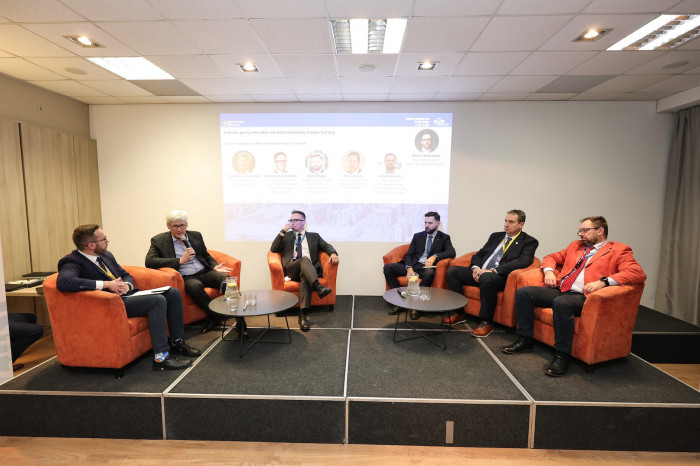
A discussion was held as part of the "Logistics Business Days in the Port of Gdansk" conference, which discussed the impact of geopolitical factors on maritime transportation.
How did the full-scale war in Ukraine change trade flows and the development of intermodal infrastructure and affect future cooperation with Polish ports? This issue was discussed during the discussion panel "Polish seaports on the intermodal map of Europe - cooperation with Ukraine: a continuing trend or a reaction to the crisis", which took place as part of the "Logistics Business Days in the Port of Gdansk" conference.
The participants in the discussion agreed that Polish ports benefited from the change in logistics routes. The redistribution of cargo flows has been in favor of Gdańsk and Gdynia. Geopolitical factors have become an incentive, and some of the new cargo routes are already becoming permanent.
The main theses from the speeches of the participants in the discussion were collected by Polish journalist Lukasz Kuś. The CTS publishes their translation.
Polish seaports demonstrate a significant increase in container transshipment. This is due to economic development and the level of cooperation with neighboring countries. However, in order for Gdańsk, Gdynia and Szczecin-Świnoujście to play a greater role in the foreign trade of neighboring countries, it is necessary to improve the infrastructure and expand the logistics offers.
A port is only one of the functions of the economy. The success of a port depends on how the economy develops and how supply chains are organized. As noted by the participants in the discussion "Polish seaports on the intermodal map of Europe", the port of Gdańsk has an extensive infrastructure not only for handling containers, but also for bulk cargo.
"We were helped by the economic situation not only in Poland, but also in all of Central Europe. The same can be said about Gdynia and the entire logistics industry. One of the consequences of the war in the east was the closure of transport channels for coal and other energy resources. These deliveries moved to ports that had the potential to handle such cargo. Today, container traffic is developing, which is a result of the growth of the Polish economy and the opening of the Ukrainian market," said Bartłomiej Felczyński, Manager of Strategy and Development of Land Transport at the Port of Gdańsk.
In Gdynia, they confirm that they also felt a similar impulse against the background of geopolitical factors. "The demand for transshipment, which arose due to the outbreak of the war in Ukraine, allowed us to use the potential of this port. Terminals have partially changed their offers. New trade routes have appeared that may become permanent," said Adam Hoppe, Director of the Strategy and Market Analysis Department at the Port of Gdynia.
The participants of the debates assessed the impact of geopolitical factors on ports differently. "Container traffic volumes are indeed growing. But I believe that the recent coal peak was a disaster, since terminal operators and PKP Cargo are still licking the wounds from that period. Currently, ferry and ro-ro traffic are developing well. We are seriously considering the possibility of transporting only trailers by ferry instead of entire road trains. We are also in talks with German inland ports, which are part of the inland areas of Szczecin and Świnoujście, about launching inland transports that will serve container traffic from the planned new deep-sea terminal. I assume that approximately 10% of containers from the Świnoujście terminal will be transported by barges," said Rafal Zachorski, a representative for port development at the Szczecin and Świnoujście Sea Ports Authority. Intermodal operators, which are launching connections between the Tricity and neighboring countries, also speak about the development of Polish ports. "We have been working in Poland for several years and see very positive development not only in Gdańsk, but also in other ports and in the entire intermodal market. When we launched the train between Gdańsk and Ostrava, it was initially difficult to convince Czech customers to use the Polish port, as Hamburg has an extensive network of connections with the Czech Republic. The situation in Germany helped us - the congestion of their ports and the repair work on the German infrastructure. This allowed us to convince some customers to choose Gdańsk. And it turned out that this service works," said Milan Šimek, Business Development Manager for Poland at METRANS.
"Gdańsk is a good place for us, and we have good relations with the port and sea terminals. We are developing a network of intermodal terminals in Ukraine. One of them, in Mostyskie, is located on the Polish border and serves connections with the port of Gdańsk and other places in Europe. I believe that the region of Western Ukraine will remain logistically connected to Gdansk, even if traffic in the Odessa port is fully restored," said LEVADA CARGO General Director Volodymyr Demenko.
During the debate, the question of the future of intermodal transport between Ukraine and Poland after the end of the war arose. "Before the war, approximately 1 million TEUs were transported to Ukraine annually. Currently, this volume has decreased to 500,000 TEUs, of which the Baltic hub handles approximately 180,000-200,000 TEUs. Of this amount, approximately 100,000 are transported to Ukraine by train, and the rest by trucks. It is important to remember: immediately after the war, container transport included cargo that was not supposed to be transported in containers. These goods have now returned to Odessa. Polish ports also offer a full portfolio of logistics services that are not available in the Black Sea ports. Therefore, we expect that after the end of the war, some cargo to Ukraine will continue to be transported via Poland," added Bartłomiej Felczynski.
A separate part of the debate was devoted to the development of the North-South corridor and its importance for Polish ports. The representative of the Szczecin-Świnoujście ports drew attention to the infrastructure limitations in western Poland, which currently hinder intermodal transport.
"North-South connections are well developed in the Tricity area. However, in western Poland we aim to maintain infrastructure at least as good as in central Poland. Currently, trains with a maximum length of 630 meters can depart from Świnoujście to the south, which negatively affects the economics of intermodal transport. According to the announcements, trains with a maximum length of 740 meters should be introduced by the end of next year, and by 2028, priority will be given to intermodal transport on Nadódzianka. If this line is well organized, it will be able to take over the traffic from the new container terminal in Świnoujście. After the war in Ukraine ends, Poland will experience a significant movement of construction cargo and equipment, and Polish transport must prepare for this," said Rafal Zagorski.
"We need to remember the capacity of border crossings. Even after the war began, there was a problem with handling additional volumes. The question is when will the reconstruction plan for Ukraine begin? METRANS now runs regularly between Gdańsk and southern Europe. "We are also launching intermodal connections not only between ports, but also with countries such as Romania. We currently see that the reconstruction of infrastructure, especially in Slovenia, is a limitation of the North-South corridor," said Milan Šimek. Polish ports are part of the North-South corridor, but their potential has not yet been fully exploited. "Gdynia is a node of the Baltic-Adriatic corridor. Access to the transport network is a serious challenge for us today. Trains from the port must pass through the entire Tricity area. That is why we support the project to modernize line No. 201, but it will not be completed until 2032. Access to roads is also a problem. The Red Road is also planned to be completed no later than 2032. The port and its railway station are currently ready for intermodal transport, but access to the transport network needs to be improved," says Adam Hoppe.
"The problem of the North-South Corridor lies in the border crossing points with both the Czech Republic and Slovakia, as well as Ukraine. It is necessary to create a platform for mutual understanding between ports, state administration and the logistics industry in order to expand the support base of Polish ports to the south. There is also a lack of allocations for the Czech Republic and Slovakia on ships heading to Polish ports. "More activity is needed from both port administrations and the logistics industry to develop connections with countries south of Poland," concluded Bartłomiej Felczynski.