
UNUSUAL: HOW THE MARKET REACTS TO PORT RESTRICTIONS
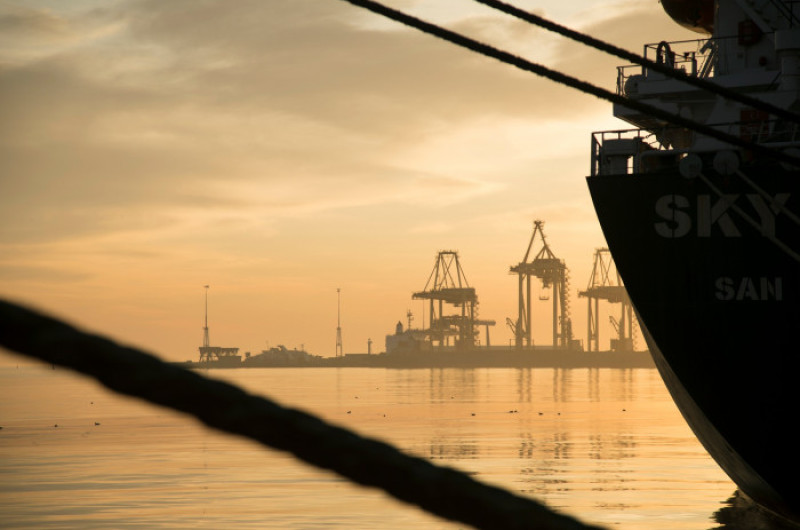
The war continues, and now Ukrainian ports are experiencing a new round of restrictions in their work, provoked by Russian shelling of merchant ships. As in 2022, both government officials and exporters speak of the need to develop alternative routes for cargo transportation. What changes in logistics are already being observed or can be considered?
The current situation has affected everyone: agrotraders, container lines, mining and metallurgical complex, etc. There are only two alternatives to seaports: either Danube ports or western railway crossings. And although they cannot fully take over sea exports, it is important to use reserve capabilities to the maximum now.
"The government, diplomatic corps and all responsible state institutions are working 24/7 to restore the normal operation of ports. This issue is under the personal control of the President of Ukraine," assured Prime Minister of Ukraine Serhiy Koretsky. According to him, the work is coordinated with international partners, but much depends on the Ukrainian military.
"Ukrzaliznytsia" is working on "Plan B"
"Ukrzaliznytsia" said that due to the suspension of ships' calls to the ports of Greater Odessa, it is preparing "Plan B" for transporting cargo. There are 16 border freight crossings in western Ukraine. During the day, they are capable of transferring approximately 3,600 wagons, but in fact, up to now, the capacity has been used by a third.
"Ukrzaliznytsia" promised to focus on those directions in which shippers are currently most interested. In particular, additional personnel will be attracted to improve the throughput capacity of border crossings. In addition, UZ is trying to return locomotives damaged by Russian strikes to service as soon as possible.
Deputy Director of the Department of Transportation Technology and Commercial Work of JSC "Ukrzaliznytsia" Valeriy Tkachev reported that the company has approximately 3,850 bogies for rearranging wagons so that they can travel on a 1,435 mm gauge. However, it is now necessary to check the condition of these bogies and how many are needed.
Depending on the stations, there are currently difficulties with the inspection of freight trains by representatives of the relevant regulatory services of Poland or other neighboring countries, there is a lack of traction rolling stock or there is no electric centralization of switches, which slows down the organization of route preparation.
"Ukrzaliznytsia" asked shippers to provide information on priority directions for the export of agricultural products. And at a meeting with business, she promised to promptly hold meetings with carriers from Poland, Romania, Moldova, Hungary and Slovakia and discuss infrastructure capabilities for transferring cargo in the conditions of temporary restrictions on the work of the ports of Greater Odessa.
The company "Vilia" believes that the shortage of logistics capabilities will affect corn the most, although Ukraine will be able to export corn to European countries or in transit through them. "If the situation with the blocking of ports is not resolved during the marketing year, it is quite logical to expect significant transitional corn residues," predicts the commercial director of "Vilia" Taras Kovatsenko.
According to Spike Brokers, the sale of corn residues from the old harvest has intensified on the western border. However, the capabilities of this channel remain limited not only by the Ukrainian transshipment infrastructure, but also by the situation in European logistics, analysts note.
"Large-scale repair work on key railway routes to Italy and Germany via the Czech Republic is slowing down the speed of cargo movement and limiting opportunities for increasing exports," the report says.
The situation with wheat is not simple either. Ukraine itself processes only a small part of the wheat it grows, and Europe is not a traditional consumer of Ukrainian wheat. "Last year, the practice of quotas for its imports to the EU was resumed. Currently, the Ukrainian quota has already been exhausted, and exports beyond its limits are economically inexpedient," says Kovatsenko from Vilia.
According to him, wheat can only be exported in transit, building longer logistics routes, for example, through the ports of Poland or Romania. However, the throughput capacity of these logistics channels is many times less than the required export volumes. Therefore, he advises leaving wheat in a long position "as the least liquid crop at the moment." At least, this can be done by farms whose financial condition allows not to sell the entire harvest at once.
However, agricultural associations stated that currently the delivery of grain through the western borders has increased logistics costs by 40-60 dollars per ton, and together with the increase in the tariff of "Ukrzaliznytsia" by 30%, the cost of delivering a ton of grain will make growing unprofitable.
Danube nuances
The First Deputy Minister of Reconstruction, Infrastructure and Transport of Ukraine, Serhiy Derkach, stated earlier that the possibility of increasing the capacity of Danube ports is being discussed together with Romania.
Recall that last year, more than 8.9 million tons of cargo were handled through the ports of Izmail, Reni and Ust-Dunaysk. However, the capacities are much higher. In 2023, the operaport operators operating on the Danube handled 32 million tons of cargo.
Then the cargo turnover of the port of Izmail more than doubled and reached 20.2 million tons (8.8 million tons in 2022); the port of Reni - 10 million tons (6.8 million tons in 2022); the port of Ust-Dunaysk - 1.7 million tons (785 thousand tons in 2022). And transshipment was carried out wherever possible - not only directly in the ports, but also on the territory of ship repair yards, etc.
Currently, transportation on the Danube is limited due to falling water levels. However, this is not the first time that ports and shipping companies have faced this problem.
"In fact, in 2-4 weeks it should rain and the water level in the Danube should rise, and then we will be able to establish grain logistics. And not only from Ukrainian ports. Yes, these are not the ports of Greater Odessa, but at least something. Every year the Danube dumps water somewhere for a month. And logistics with it becomes difficult. By the way, this is also the reason for fuel supply disruptions and the impact on its price," says the founder of Prime Group Dmitry Lyushkin.
Ferrexpo told how in 2022, when the Danube became shallow in the summer, logisticians found a way out of the situation. Then the shipping company First-DDSG put empty barges on the shoals, where loaded barges could not pass. Part of the cargo was reloaded, the barge rose and passed the shoal.
"This was a forced step for several weeks, and it made it possible to process the vessels and continue logistics. Otherwise, the vessels would simply be idle and would not have the opportunity to work," explained Dmitry Spatar, First Deputy Chairman of the Board of PrJSC Poltava GOK, in the spring of 2023.
He noted that the company traditionally shipped about 10% of its products along the Danube. For sea transportation to Western Europe, the Middle and Far East, etc., Ferrexpo used the port of Constanta, while part of the cargo then went through the Polish port of Gdansk.
Currently, the frantic demand for transportation from the Danube ports of Ukraine to Constanta, which was in 2022, is not observed. Although demand has increased, the low water level limits loading. Therefore, shipowners are increasing rates and are not ready to work at lower rates, and farmers are not ready to overpay, the industry says.
And, for example, "Nibulon" managed to conclude a contract with the Romanian company TTS Transport Trade Services S.A. and within four months its caravans will make flights between Romania, Serbia and Bulgaria, and not between Izmail and the Constanta roadstead, where the company worked before.
"The Danube can be used as an alternative option, but we need to return to practices that would allow logistics to work quickly: minimize unnecessary checks and controls, ensure transit without delays, so that cargo is not delayed at individual stages and the entire chain works," says Dmytro Barinov, president of the Ukrainian Ports Association "Ukrport".
Different cargoes - different needs
If we talk about shippers, then the new logistical difficulties are discussed most by farmers. According to the results of the first half of 2026, Ukrainian seaports processed 42.4 million tons of cargo, 23.6 million tons of which were agricultural products.
The All-Ukrainian Agrarian Council stated that a prolonged pause in the work of Ukraine's seaports threatens to create a surplus of agricultural products, which will put pressure on the market throughout the marketing year, and purchase prices are already even lower than the full cost of production.
Ukraine needs to export about 67 million tons of agricultural products. However, if seaports are stopped, export opportunities may be reduced to 1.7 million tons per month, the VAR noted. The Ukrainian Grain Association, in turn, notes that exports in the new season could potentially reach almost 52 million (last season it amounted to 41.1 million tons).
At the same time, representatives of the mining and metallurgical sector are more restrained, although, of course, MMC depends on the work of seaports.
The Southern Mining and Processing Plant (Kryvyi Rih) temporarily suspended work - several ship loads of iron ore, which were supposed to be exported, accumulated in the ports and warehouses of the mining and processing plant.
The failure of seaports also forced the Poltava Mining and Processing Plant to suspend work. The company explained this by the impact on liquidity - Ferrexpo expects available funds for work next month. Although this depends on iron ore prices, operating costs and other factors.
Earlier, the industry talked about a decrease in demand for ore and metal products in key markets, the difficulty of accessing the EU market due to the introduction of CBAM, etc. So in the first half of the year, the total volume of railway cargo transportation of the mining and processing plant decreased by 20% year-on-year, or by 7.6 million tons - to 31.4 million tons.
Business notes that the blocking of the Ukrainian sea corridor weakens positions in world markets. For example, Interpipe recently announced that the European Union has introduced a new system of tariff quotas for steel imports and the company is interested in increasing its share in other markets. Interpipe has exhausted a significant part of its quarterly quota for the export of seamless pipes to the EU, and next month it will need to continue supplies to Europe.will pay a duty of 50%.
"Chinese seamless pipe manufacturers have already completely exhausted their quota in the EU and are directing excess production to other markets, creating additional competition there," said Natalia Sydoruk, GR Director of Interpipe. Therefore, "the constant complication of logistical restrictions due to the systematic shelling of Ukrainian seaports" is of concern to the company.
Interpipe informed the Central Trade and Investment Committee that the closure of seaports has already led to the need to reorient Interpipe's export volumes to one of the ports in Europe.
Therefore, despite the obstacles posed by the aggressor, the business continues to restructure logistics and look for affordable alternatives. However, it is clear that replacing the export capacities of seaports in the long term would be difficult. Therefore, the main lever in restoring the operation of the Ukrainian sea corridor is again in the hands of the Ukrainian military and diplomats.